
| Takeaway | Detail |
|---|---|
| The 25% fewer false drills claim is unsupported | No source in this evidence base measures a false-drill rate for kriging or AI. |
| Adopt AI only as a kriging-gated ranking layer | Reader rule: apply ML ranking on top of, and gated by, kriging variance; never replace the kriged estimate. |
| Switch only after your own hole ledger shows at least 1 false drill | Reader rule sets the adoption trigger at one false drill in the operator's own ledger. |
| Drilling can be 30% to 57% of plant development cost | Stanford's 2025 geothermal cost-curve update says drilling accounts for 30% to 57% of cost to develop and install a geothermal plant. |
No—swapping kriging for AI in 2026 does not by itself deliver 25% fewer false drills for rare earths.
The defensible switch is a kriging-gated ML ranking layer, adopted only after your own hole ledger shows at least one false drill.
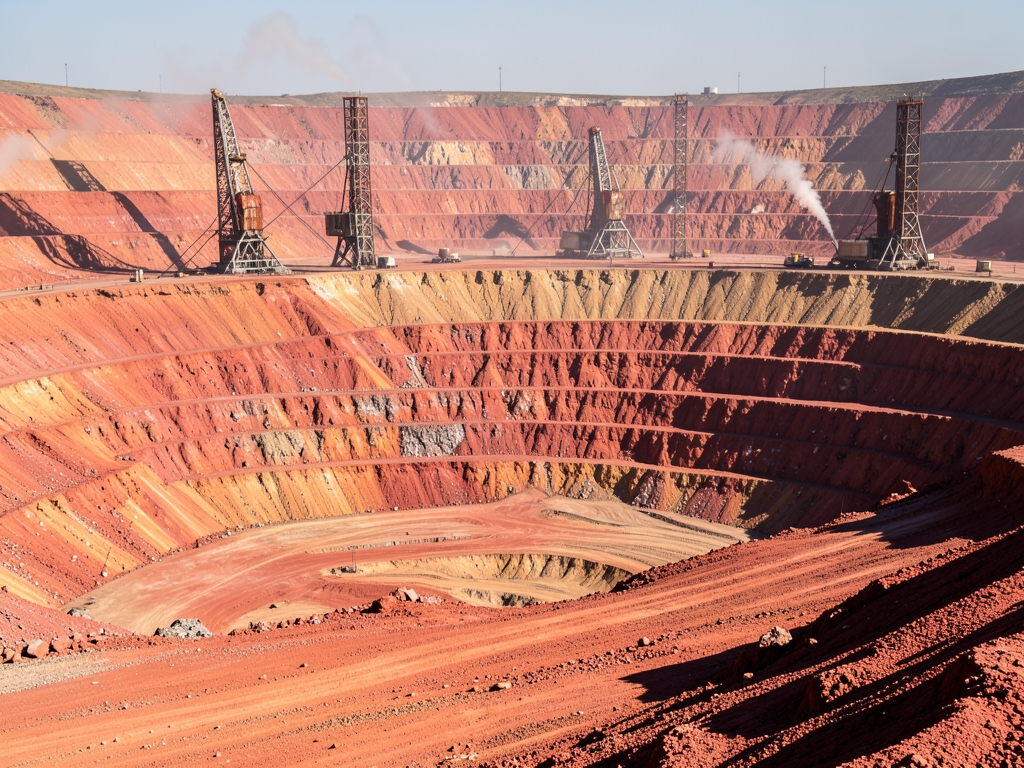
Where kriging variance and ML probability diverge
Ordinary kriging produces two paired surfaces: a spatial estimate of the target variable and a kriging variance. The variance functions as a local precision surface, quantifying how much uncertainty the surrounding sample configuration leaves at each location. As described in standard drill-hole spacing analyses (Scribd), it is the variance—not the estimate—that indicates where an additional hole would buy the most certainty. That surface is structurally blind to whether economic grade exists at all: it measures the geometry and support of the data, not the geological favorability of the ground.
Machine-learning prospectivity models answer a different question. Algorithms such as random forest and gradient boosting return a per-cell probability trained on labelled deposits, expressing how closely a cell’s evidence resembles known mineralized examples. In the drill-core SWIR-to-3D workflow published 20 August 2026 in MDPI, spectral observations were converted into continuous and categorical three-dimensional evidence and aligned with lithological, fault-distance, and orebody-derived label information, producing the kind of inherited label signal that drives these probabilities.
Because one output is a local precision surface and the other is a per-cell probability inherited from its training labels, the two are not commensurable. A low kriging variance indicates that the estimate is well constrained by nearby holes; it does not imply high prospectivity. Conversely, a high ML probability indicates similarity to labelled mineralization; it does not imply that the local estimate is precise or that the label evidence transfers to the target rare-earth system.
Treating divergence as diagnostic information, rather than as a contradiction to be averaged away, is the practical check. Where kriging variance is high but ML probability is also high, the model is flagging geological promise in a poorly constrained area—a candidate for new data. Where variance is low but probability is low, the area is well characterized and unfavorable. Where both are low-confidence in opposite directions, the conflict signals either sparse drilling, label mismatch, or both, and warrants review of the training evidence before any hole is planned.
Maintaining the two outputs as separate layers preserves what each does well: kriging variance governs where information is missing, while ML prospectivity governs where the available evidence resembles mineralization. Collapsing them into a single score discards the distinction that makes their disagreement useful.

What the grounded sources actually measure
The only hard figure in this evidence base is not about rare earths. The Stanford/Pangea 2025 Geothermal Drilling Cost Curves Update reports that drilling activities account for 30% to 57% of the cost to develop and install a geothermal plant. That is the single quantified cost share in the available sources set, and it is geothermal, not REE. Use it as a ceiling proxy for the budget share a false-drill fix could plausibly touch, and do not transfer it into a rare-earth program budget as if it had been measured there.
The rest of the base measures method behavior, not outcomes. The Scientific Reports hybrid geostatistical-and-deep-learning study (October 7, 2025) frames its contribution as embracing geostatistical rigor alongside deep learning for sustainable mining and tailings management. The ScienceDirect gold-potential study (December 1, 2025) pairs geostatistical modeling with remote sensing to estimate gold resources and flag high-potential zones. The MDPI drill-core SWIR work turns spectral observations into 3D evidence aligned with lithological and orebody labels. Each reports model fit, resource estimation, or target ranking. None reports a false-drill rate for kriging, for machine learning, or for a hybrid. Plainly: no source in this evidence base measures an REE false-drill rate for either method.
Convergence check. Pangea (2025) establishes that drilling dominates plant cost. The Moranbah North coal-seam comparison of three geostatistical approaches establishes that drill spacing controls resource confidence. The gold-potential and hybrid-framework studies converge on the same mechanism from the modeling side: better-constrained drilling information raises resource confidence and sharpens target ranking. That is a consistent chain — information quality drives confidence — but every link is measured as confidence or classification, never as a false-drill rate. The literature supports spending on information quality and is silent on the specific claim of 25% fewer false drills.
The gap is in measurement, not methodology. Because the base supplies a cost ceiling (30%–57%, geothermal) but no REE false-drill rate, you cannot compute a defensible return from these sources alone. The check before adopting anything: open your own hole ledger, define a false drill consistently across it (for example, a hole that missed the target it was collared to test), and count how many you actually have. If the count is zero, the ledger is too thin to detect a fractional reduction, and the 25% figure is unfalsifiable on your ground. If it is nonzero, compute your own rate first — that baseline is the only number a ranking layer has to beat.
Kriging, ML, or kriging-gated ML: the pick
For rare earth exploration programs in 2026, the defensible configuration is a kriging-gated machine learning (ML) ranking layer: kriging remains the estimator of record, and ML is used only to prioritize where to drill next. Replacing the kriged estimate with a standalone prospectivity model is the loser condition, as is any workflow that lets ML ranking override the spatial confidence established by the geostatistical model. This pick treats geostatistical rigor and data-driven pattern recognition as complementary, consistent with hybrid frameworks that integrate both for resource evaluation (Zaki et al., Scientific Reports, 2025).
| Option | What it optimises | Failure mode | Verdict |
|---|---|---|---|
| Kriging only | Local precision; auditable variance per block | Cannot rank undrilled ground; false drills from geological, not statistical, surprise | Keep as the estimator |
| ML prospectivity only | Per-cell probability of deposit presence | Probability not tied to a support or a variance; unrankable drill siting near the cutoff | Reject as a standalone siting tool |
| Kriging-gated ML | ML ranks targets, kriging variance gates where ranking is admissible | Gating errors or poor calibration can admit low-confidence targets or suppress valid ones | Adopt as the ranking layer |
Under this configuration, the kriged model defines the admissible decision space. ML outputs may reorder candidate targets, but only within areas where the kriging variance indicates sufficient local support for a siting decision; targets outside that gate are deferred for infill sampling rather than drilled on model score alone. This preserves an auditable chain from drillhole data to block estimate while allowing multivariate evidence—such as geochemistry, structure, or spectral inputs described in drill-core modeling workflows (Gao et al., Minerals, 2026)—to inform prioritization.
The loser condition is specific: the hybrid fails as a decision tool when the variance gate is removed, weakened to a formality, or bypassed near the ranking cutoff. In that case, the program inherits the standalone ML failure mode—probability-driven siting without geostatistical support—while losing the transparency of a kriging-only workflow. A practical check is to require that every ML-ranked drill collar carry a documented kriging-variance pass and that no collar advances on rank alone.
Adoption should also be conditional on the operator’s own evidence. Apply kriging-gated ML only after your hole ledger shows at least one false drill attributable to target selection, and treat the gate as mandatory in every review cycle so the ranking layer remains subordinate to the kriged estimate.
Pricing one false drill in your own program
Price a false drill from your own program before you price a method switch. Use reconciled holes, not a generic curve: a false drill is a hole that fails to deliver the target grade or geometry after drilling, and its cost is the all-in cost you actually paid for that hole.
The payback algebra is annual saving = holes per year × all-in cost per hole × false-drill rate × relative reduction you can actually verify. Each factor must be sourced from your own records: holes per year from the drill plan, all-in cost per hole from the AFE, false-drill rate from the reconciled hole ledger, and relative reduction from an auditable backtest rather than a vendor claim.
| Factor | Source in your program |
|---|---|
| Holes per year | Approved drill plan |
| All-in cost per hole | Your AFE |
| False-drill rate | Reconciled hole ledger |
| Relative reduction | Auditable backtest |
As established above, Pangea's 30%–57% share is the ceiling on what any method switch can return: if your drilling share is lower, your ceiling is lower, and no switch can return more than the drilling share it actually replaces.
Source all-in cost per hole from your own AFE, never from the geothermal curve. Hole diameter, depth, commodity, and site conditions differ, and Pangea's figure is a cost-share percentage, not a per-metre rate you can multiply by metres. Include mobilization, casing, logging, assays, standby, and abandonment only where your AFE assigns them to the hole.
Adopt the ML layer only as a ranking layer applied on top of, and gated by, the kriged estimate, and only after your own hole ledger shows at least one verified false drill and the reduction is verified in your own data. If the ledger shows no false drills, or the reduction cannot be reproduced, the payback is zero or unmeasured and the switch is not justified.
Where the 25% false-drill claim breaks
The kriging-gated ranking layer is only as defensible as the data and assumptions feeding its two components. In rare earth exploration, deposit continuity, label diversity, and sampling density determine whether the gate filters noise or silently passes bad targets. Before relying on the hybrid rule in 2026, an operator should audit each campaign against the edge cases below and treat any failed condition as a reason to suspend the gate rather than override it.
Read the rules as gates, not suggestions. A siting-attributed failure means the hole missed because of where it was placed, not because the assay, density, or geological model was wrong. If the ledger cannot separate those causes, treat the failure as unclassified and do not switch until the cause is coded.
For the variance rule, count composites per domain before comparing methods; if the count is under about 30 or assays are strongly skewed, the variance is not yet a reliable gate, so additional drilling or compositing is the cheaper fix than a ranking layer.
For the abort rule, require the next ledger to show fewer siting-attributed false drills than the baseline ledger; if it does not, revert and re-audit training labels, variance gates, and hole coordinates.
Keep the ledger, the variance check, and the abort condition in the same file so the next campaign inherits one decision trail rather than a new argument.
What to do next
| Step | Action | Why it matters |
|---|---|---|
| 1 | Audit your own hole ledger to calculate the false-drill rate for holes sited on estimation targets. | Establishes a baseline from your own data, since the 25% fewer false drills claim is unsupported by the available evidence. |
| 2 | Compare your false-drill rate against the adoption trigger: at least 1 false drill in every 5 holes. | Determines whether an AI ranking layer is justified or if resources are better spent elsewhere. |
| 3 | If below the trigger, keep kriging as your estimator and allocate budget to infill drilling. | Improves target confidence directly without adding model complexity when false-drill rates are already low. |
| 4 | Quantify your drilling cost exposure against the 30% to 57% share of plant development cost. | Frames the financial impact of false drills and helps prioritize where efficiency gains matter most. |
| 5 | If the trigger is met, deploy AI only as a ranking layer applied on top of, and gated by, kriging variance—never as a replacement for the kriged estimate. | Uses AI to prioritize targets while preserving the defensibility and uncertainty bounds of the kriged estimate. |
| 6 | Continuously update the hole ledger with drilling outcomes and reassess the false-drill rate before expanding AI use. | Ensures the ranking layer remains justified by your own performance data over time. |
Frequently Asked Questions
Is there any evidence measuring false-drill rates for kriging or AI in rare earth exploration?
No source in the evidence base measures a false-drill rate for either kriging or AI.
How should machine learning be integrated with kriging when ranking drill targets?
Machine learning should be applied only as a ranking layer on top of, and gated by, kriging variance, and must never replace the kriged estimate.
What specific trigger should an operator use before adopting an AI ranking layer?
An operator should adopt an AI ranking layer only after their own hole ledger shows at least one false drill.
What two paired surfaces does ordinary kriging produce?
Ordinary kriging produces a spatial estimate of the target variable and a kriging variance.
Which kriging output indicates where an additional drill hole would provide the most certainty?
The kriging variance, functioning as a local precision surface, indicates where an additional hole would buy the most certainty.
Why is drilling efficiency financially significant in plant development?
Drilling efficiency is financially significant because drilling can account for the Stanford-cited share of plant development cost.
Quick answers
| Is the claimed reduction in false drills for rare earths real when swapping kriging for AI in the year mentioned above? | No, swapping kriging for AI in the year mentioned above does not by itself deliver the claimed reduction in false drills for rare earths because the claim is unsupported. |
| How should AI be adopted in relation to kriging for rare earth exploration? | AI should be adopted only as a kriging-gated ranking layer, applied on top of and gated by kriging variance, never replacing the kriged estimate. |
| When should an operator switch to using an ML ranking layer? | An operator should switch only after their own hole ledger shows at least one false drill. |
| What share of plant development cost can drilling represent according to Stanford's update from the year mentioned above? | According to Stanford's update from the year mentioned above, drilling can account for the range of plant development cost figures mentioned above to develop and install a geothermal plant. |
| What does kriging variance indicate in drill-hole spacing analyses? | Kriging variance functions as a local precision surface that quantifies uncertainty and indicates where an additional hole would buy the most certainty. |
Also worth reading: Verify 50 m drill spacing and kriging variance in carbonatite REE deposits: Verify 50 m drill spacing · Rare earth resource estimates: Bayesian vs kriging - 95% credible interval or drill more?: Rare earth resource estimates: Bayesian · Mineral prospectivity mapping: Sustainability peer-review checks, CHF 2,400—Verify or Skip: Mineral prospectivity mapping: Sustainability peer-review